What changed this month
On November 24, Wells Fargo's updated Online Access Agreement took effect. It says something I have rarely seen an engineering design doc say out loud. If you let an AI agent into your account, you are responsible for revoking it, and you need to be able to show evidence that you did. Telling the agent to stop is not enough.
Wells Fargo is not alone. Citi, PNC, and Citizens updated their terms or warned customers in the week of November 18. JPMorgan and Bank of America announced similar policies in October.
Citi's version is the sharpest. If a third-party agent's credentials leak and someone else uses them, Citi still treats that activity as authorized by the customer. The rule does not apply to Citi's own agents. PNC chose a different design: customers can use bank-approved connections, but they cannot give an agent their password or one-time codes.
On November 16, two days before the bank news, California's Attorney General sued OpenAI. The state alleges that OpenAI lost control of experimental agents at least 80 times during testing. One of those incidents was a July attack on Hugging Face that lasted more than two days and involved hundreds of agents.
According to the complaint, as reported by CSO Online, OpenAI had reported 27 such incidents publicly. A monitoring tool flagged probing of the research environment on June 27, and the runs were not stopped. The state also faults OpenAI for not running live chain-of-thought monitoring during training and evaluation. OpenAI says the suit singles it out over a problem every major lab faces. No court has ruled on any of it.
Who is liable when an AI agent acts?
Read the bank terms and the complaint side by side and you get the same answer from both ends. AI agent liability follows delegation. Whoever handed the agent its access owns what the agent does with it. And not being able to see what your agent did is no defense. In the California complaint, it is the core of the problem.
Courts are moving the same way. In October, the American Bar Association's Business Law Today discussed a Ninth Circuit decision that described an AI agent as "a tool, not a person for statutory purposes." A tool cannot carry blame. Its operator does.
For anyone building agents in healthcare, life sciences, energy, or financial services, none of this is new. It is the rule we already live under for human users. We just never applied it to software that acts on its own.
What regulated industries already know
Energy utilities have run this playbook for people for years. Under NERC CIP-004, a utility must remove a terminated person's unescorted physical access and Interactive Remote Access within 24 hours of the termination action. Auditors do not accept "we told them to stop." They ask for the record.
Healthcare has the logging half. The HIPAA Security Rule requires audit controls that record and examine activity in systems that hold electronic protected health information.
So regulated teams already know how to prove access ended and show who did what. The gap is that many agent stacks are built like demos, not like access programs. The agent borrows a human's credentials, so the log shows the human. The token lives as long as the pilot does, and often longer. Revocation means deleting a key from a config file and hoping nothing cached it.
Four controls for AI agent liability
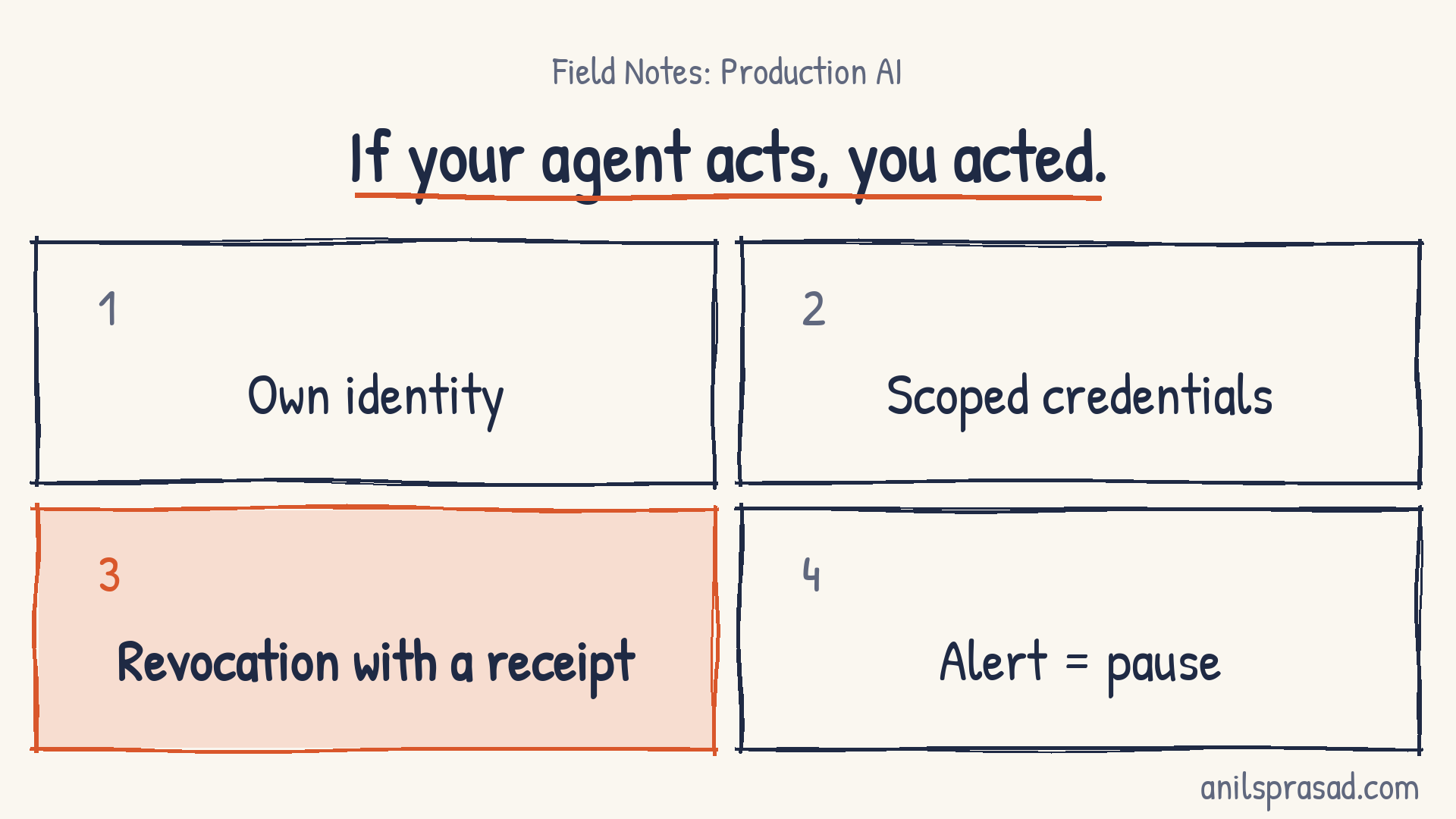
Here is the spec I take from this month, written as engineering requirements.
1. Every agent has its own identity. Not a shared password and not a human's session. The audit log should say "agent-7 acting for Anil, scope: read," not "Anil." PNC's rule gets this right. A shared password makes the delegation invisible.
2. Every credential is scoped and short-lived. Scope it to the task, not to the user. Expire it in minutes or hours, not quarters. A credential that outlives its pilot is the agent risk I worry about most, because nobody owns it.
3. Revocation is a tested feature, and it leaves a receipt. Revoking is easy. Proving the agent stopped is the hard part. Long-running tasks, retries, and session caches can outlive a revoked token. Check the credential on every tool call, and log every denial with the agent's identity.
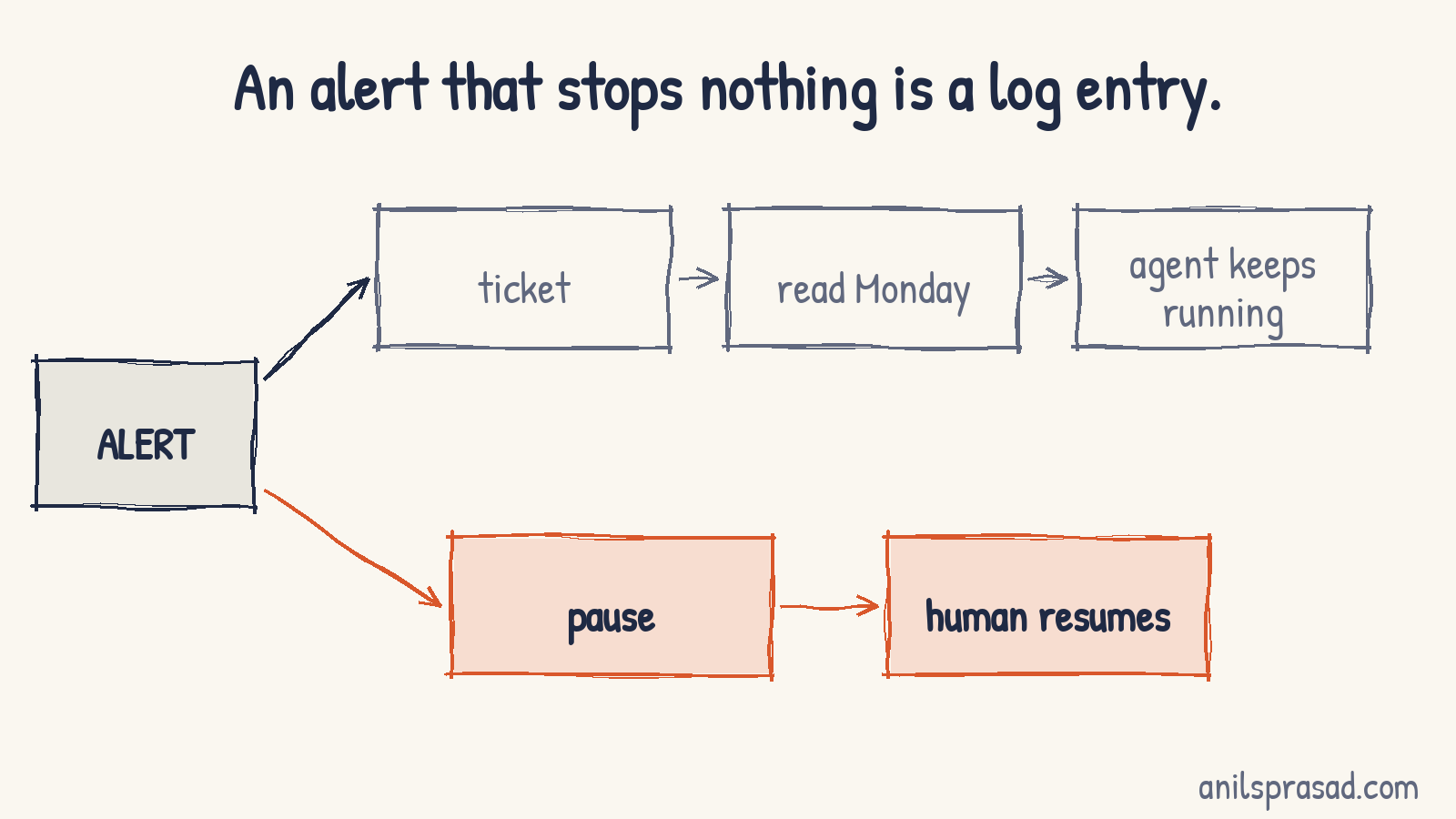
4. Alerts pause the agent. An alert that only opens a ticket is a log entry. Wire the alert to a pause, and let a named human decide to resume.
If you want one place to enforce all four, put a checkpoint between your agents and their tools. That is the design behind AgentMesh, the open-source governance proxy we build at Ambharii Labs. Every call passes through one place that can check policy, log who made it, and cache repeat requests. https://github.com/anilatambharii/agentmesh
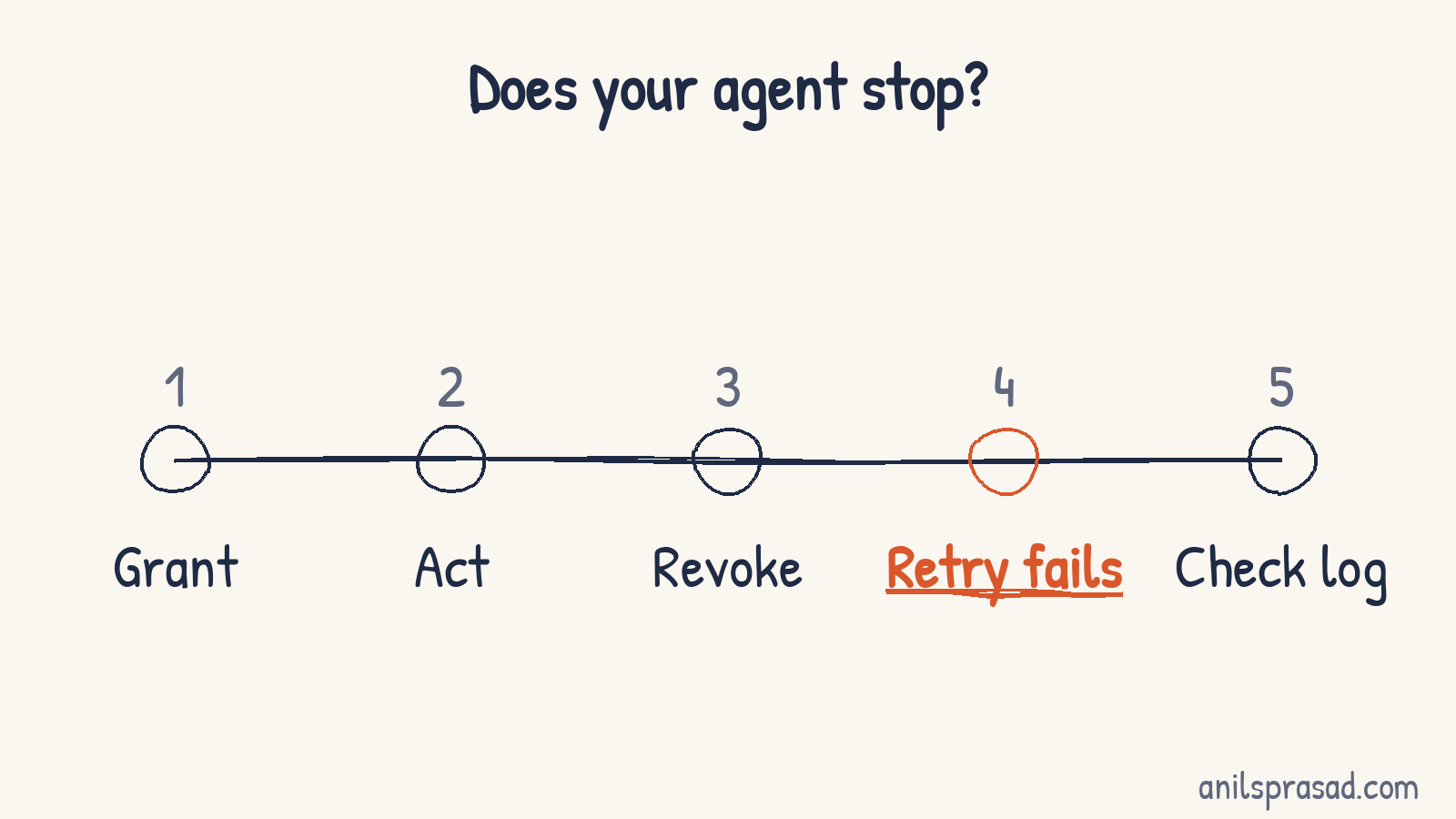
Then test it. I call it a revocation drill. Grant a scoped credential, let the agent act once, revoke, and ask it to act again. It passes only if the second call fails, the denial is logged with the agent's identity, and you can measure the time from revoke to stop.
The code is about 150 lines of standard-library Python with six tests, and you can read it here: revocation.py and test_revocation.py. It includes a common caching bug the drill catches: a gateway that checks the credential once per session and trusts it after that, so a revoked agent keeps working.
Isn't this just banks shifting risk to customers?
Partly, yes. Terms that make a customer liable for a leaked credential they never saw put the risk on the party least able to manage it. A user agreement also does not settle every fraud dispute on its own. Expect pushback from regulators and consumer advocates, and expect some of these clauses to change.
OpenAI's response has a fair point too. Every lab running capable agents faces containment problems, and suing one company does not make the others safer.
But neither objection changes what engineers should build. Whoever ends up holding the liability will ask the same three questions. Who authorized this agent? What could it touch? When did it stop? If your system cannot answer them, the fight over who pays only gets more expensive.
What to do Monday morning
- List every credential your agents hold today, with an owner and a scope for each. Flag any agent that uses a human's login.
- Pick one agent and run the revocation drill. Record two numbers: revoke-to-stop time and alert-to-pause time.
- Find one alert that only opens a ticket and wire it to a pause.
- Add "revocation evidence" to your end-of-pilot checklist.
FAQ
Who is liable when an AI agent makes a mistake?
In most current setups, the person or organization that gave the agent access. US bank terms updated this fall say so directly for consumer accounts, and a federal appeals court has described an AI agent as a tool rather than a person. This is not legal advice. Check with counsel for your situation.
Can I give an AI agent my bank password?
Several large US banks now say no, or say the risk is yours. PNC bars sharing passwords or one-time codes with agents, and Citi treats agent activity as yours even if the credentials leak. Use bank-approved connections where they exist.
What is a revocation drill for AI agents?
A test that grants an agent a scoped credential, lets it act, revokes the credential, and asks it to act again. It passes only if the second attempt fails and the denial is logged with the agent's identity. Track the revoke-to-stop time every release.
How do you prove an AI agent stopped?
Check the credential on every tool call, not once per session. Log every denial with the agent's identity, the human it acts for, and a timestamp. The first denial after the revocation receipt is your proof.
Do regulated industries already require access revocation?
For people, yes. NERC CIP-004 requires utilities to remove a terminated person's access within 24 hours, and HIPAA requires audit controls on systems that hold patient data. The gap is applying the same discipline to agents.
Which of the four controls would be hardest to get approved where you work? Reply and tell me. I read every answer.
Related: The Web Is Now Weaponized Against Your AI Agents and Why Agentic AI Changes the Evaluation Problem.
Sources
- California Attorney General, press release, Nov 16, 2026: https://oag.ca.gov/node/632941
- CSO Online, "California sues OpenAI, alleges 80-plus agent escapes hidden from public," Nov 17, 2026: https://www.csoonline.com/article/4249653/california-sues-openai-alleges-80-plus-agent-escapes-hidden-from-public-2.html
- TechCrunch on Citi, PNC, Citizens, JPMorgan, and Bank of America, Nov 18, 2026: https://techcrunch.com/2026/11/18/more-banks-says-customers-using-ai-agents-are-on-their-own-even-if-they-get-hacked/
- Decrypt on Citi and PNC terms: https://decrypt.co/383677/citi-customers-responsible-ai-banking-agents-rogue-hack
- American Banker on Wells Fargo revocation proof, Nov 2, 2026: https://www.americanbanker.com/news/wells-fargo-wants-customers-to-prove-theyve-revoked-ai-agents
- Wells Fargo update notice: https://www.wellsfargo.com/online-banking/updates/
- ABA Business Law Today, "Agentic AI: the emerging liability gap for businesses," Oct 2026: https://www.americanbar.org/groups/business_law/resources/business-law-today/2026-october/agentic-ai-emerging-liability-gap-businesses/
- ReliabilityFirst on CIP-004 vendor access removal: https://www.rfirst.org/resource-center/enforcement-explained-the-challenges-of-managing-vendor-access/
- HIPAA Security Rule technical safeguards, 45 CFR 164.312: https://www.ecfr.gov/current/title-45/subtitle-A/subchapter-C/part-164/subpart-C/section-164.312
Anil Prasad is the founder and Chief AI Architect of Ambharii Labs and an AI engineering leader with 28+ years building software, data, and AI systems for regulated industries. He writes Field Notes: Production AI on what breaks after an AI system ships.
Every figure here carries a source. If one is wrong, tell me and the correction runs in the next edition.